Stop listening to AI gurus
Most "AI-proof your career" advice floating around right now protects your feelings.
Not your careers or your ideas...
I'm going to walk you through the five biggest pieces of it — straight, no hedging — and show you exactly which ones hold up.
Get this wrong and you'll spend the next year sharpening a skill that still gets you cut the day the org chart changes.
That's not a guess. It already happened to 4,000 people this year...
You see...
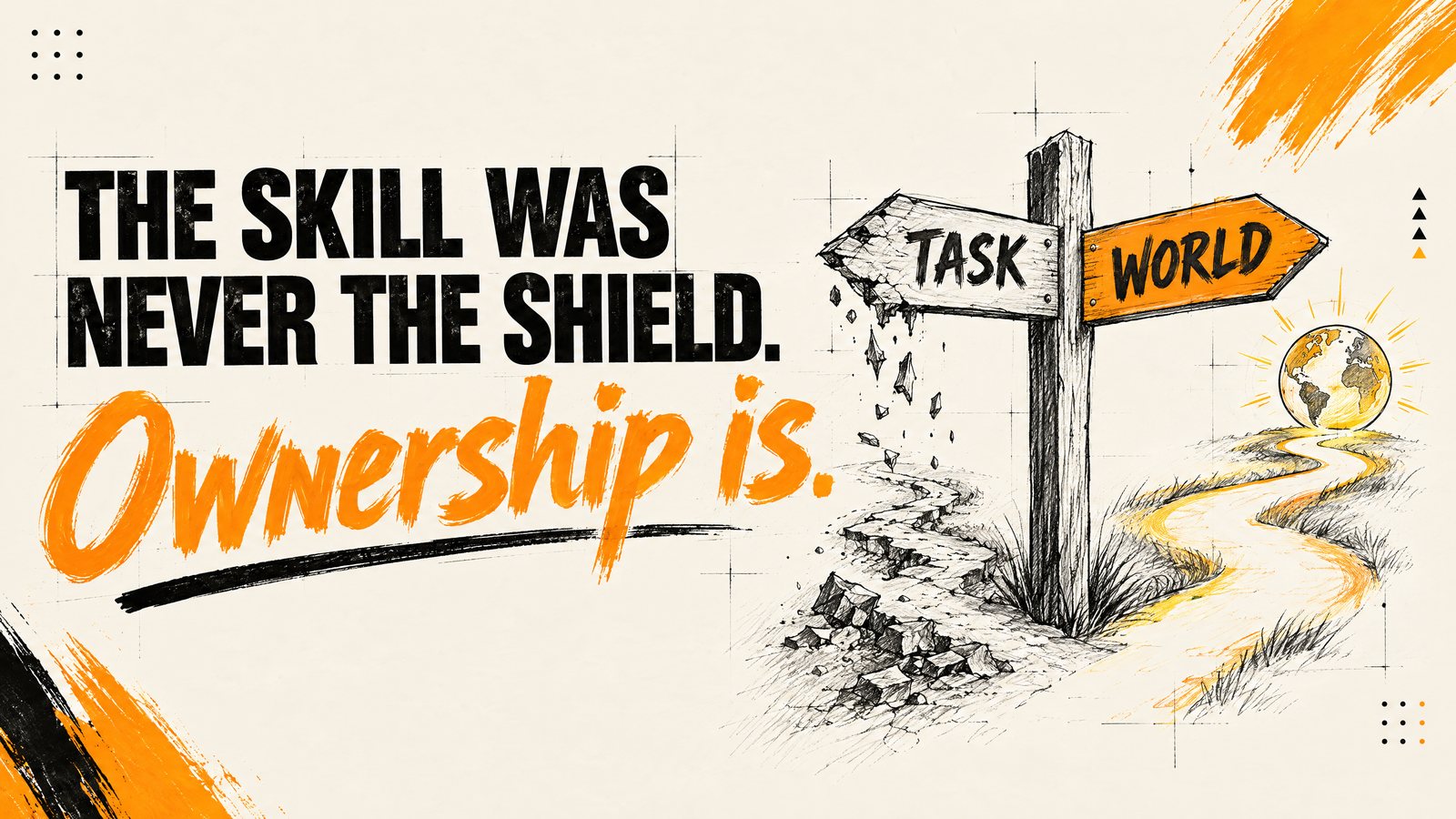
The skill was never the shield. Ownership is.
Here's what you walk away with in this essay:
- Which piece of the popular advice is a myth wearing a fact's clothes
- Why "build judgment" stopped being enough the day a company could feed it straight to AI
- The one move that actually keeps you from getting automated out of your own industry...
To better explain let's go back two weeks ago:
I remixed a post about AI-replacement strategies from Salesforce and IKEA.
Same year.
Same AI wave.
Two completely different bets.
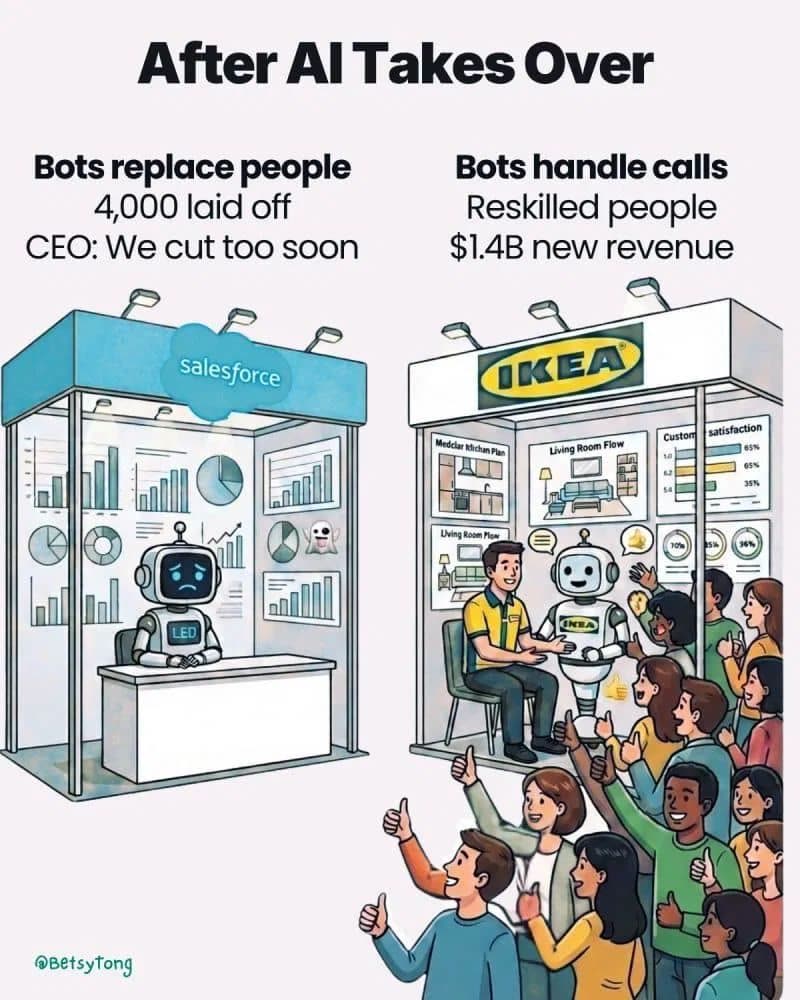
Salesforce cut 4,000 jobs. IKEA kept jobs, reskilled its call-center staff into interior design advisers instead and pulled in $1.4 billion in new revenue.
AI bots answered the outsourceable questions like "does this screw fit this cabinet."
Humans answered "how do I make 400 square feet feel like home."
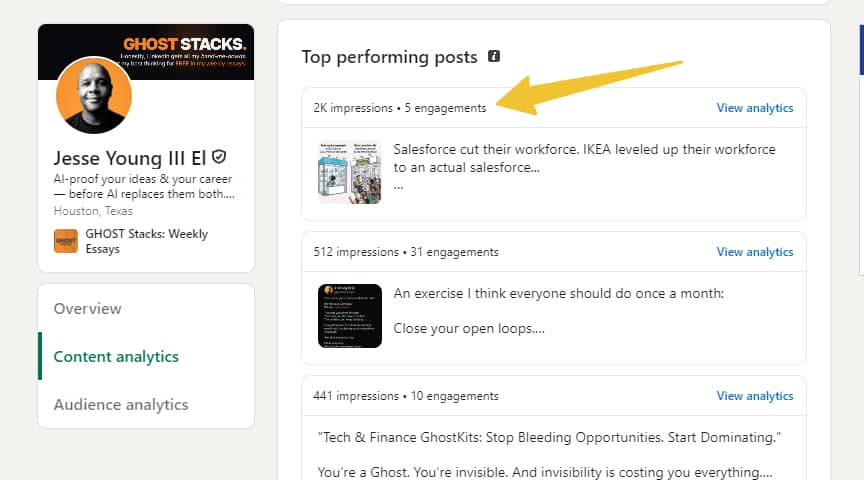
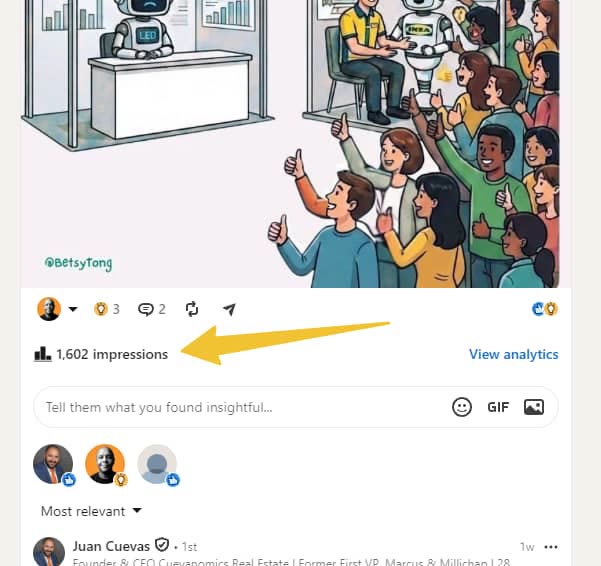
That post is the most-seen thing I've ever put on LinkedIn to date.
(I'll give you the link later on in this essay)
The algorithm pushed this out and people seemed to spend a ton of dwell-time reading and internalizing the post.
Not because of the stat.
Because of the fork-in-the-road underneath it:
👉🏾 Fork one: stay a task. AI eventually eats every task.
👉🏾 Fork two: build the one thing AI can't automate — a world that's actually yours.
That same AI-replacement fork-in-the-road is sitting in your industry right now.
And here's the secret:
AI-replacement is not a corporate call. Not an industry call.
It's yours.
That's why I push to AI-Proof your Ideas and Career — before AI replaces both...
So let's talk about the question that's been sitting in my DMs since that post went up: "How do I make sure AI doesn't make my ideas — or my career — obsolete?"
There's a lot of advice floating around on this.
Some of it holds up (sort of).
Most of it sounds smart but falls apart the second you test it.
Here's my read on five of the biggest pieces of it.
AI-Guru Advice #1. "Stop protecting tasks. Start building judgment."
AI and the productivity gurus will tell you this is the whole game: tasks get automated, judgment doesn't, so build judgment and you're safe.
WRONG. Half-right, at best.
Here's what that advice skips: your judgment doesn't just live in your head.
At some point, somebody wrote it down.
Every call you've made enough times becomes a line in the instructions — the actual document that tells the next person how your judgment works.
Those instructions aren't yours.
They're the company's property. And a company can do whatever it wants with its own property.
Including feeding it straight to AI. Sometimes packaged into an actual .SKILL file. Watching AI run the same judgment 100x faster, for a fraction of the cost, no salary attached.
I spent 20 years building other people's judgment into other people's brands.
I did the thinking. The client got the credit.
No shade — that's the deal you sign as the invisible creative.
Then AI showed up in 2021 and did something I didn't expect.
It ended the excuse for staying invisible.
Here's the move that actually protects you: stop letting your best thinking live inside somebody else's instructions.
Start capturing it and publishing it in your own brand world instead — your thoughts, your method, your name on it.
Plant the flag before the company documents your judgment for you.
Judgment doesn't AI-proof you. Owning the thing your judgment builds does.
Knowledge that compounds instead of resetting every time a platform changes the algorithm or a company changes the org chart — that's the actual moat.
Build the judgment. Then put it inside something you control, not something you're renting space in.
AI-Guru Advice #2. "Build ideas from firsthand experience."
This one I'll co-sign completely.
Test. Don't guess. Everything else is theory.
AI has read every article on your topic already.
That makes the generic idea — the one anybody could've typed into a prompt — worth less every single day.
What it hasn't read is the conversation you had yesterday. The client who almost said no and why they didn't. The thing you noticed at 11pm that nobody's packaged into a framework yet.
I never fabricate a story that isn't mine.
Not because it's a rule somebody handed me — because the moment you invent the detail, a reader who's actually lived it can tell.
The involuntary specific, the one only somebody who was actually there would think to include, is the whole proof.
AI can generate a thousand plausible case studies. It can't generate the thing that happened to you last Tuesday.
Go talk to the person. Run the experiment. Notice the problem before it's neat enough to fit in a prompt.
The closer your idea sits to something you actually lived, the harder it is for anybody, human or AI, to copy it.
AI-Guru Advice #3. "Become unusually good at asking questions."
Agreed, with one addition most people skip.
Before I let AI touch a single word for a client, I run through questions most people never think to ask.
How aware is this person of the problem I'm solving?
What have they already tried and what actually failed about it?
What are they feeling right now, before they read a word of this?
Skip that step and the output reads like it was written for nobody in particular.
Because it was.
A sharp question isn't a clever prompt.
It's proof you understand the problem deeper than the person asking you to solve it.
"Write me a marketing plan" gets you a marketing plan.
"What are we assuming about why people actually choose us, and what would prove that wrong" gets you the truth nobody wanted to say out loud in the last three meetings.
Better questions aren't a soft skill.
They're the whole skill.
AI-Guru Advice #4. "Combine AI with a skill stack that's difficult to copy."
Half right. Watch this one closely, because it wears out fast.
The advice sounds airtight: design plus AI plus psychology, sales plus AI plus relationships, nobody else has your exact combination, so you're safe.
NOPE. Not for long.
A skill stack is a moat until somebody else builds the same stack.
And once a combination gets named out loud in a post, a thousand people go build it by next quarter.
Skills get copied. Frameworks get copied.
What doesn't get copied is a story nobody else lived, wrapped around a name nobody else owns.
You don't need five capabilities stacked on top of each other.
You need one world built around the one thing only you can prove — your version of it, your name on it, your specific path to it.
That's the actual hard-to-copy part.
Not the stack. The world the stack lives inside.
AI-Guru Advice #5. "Develop a reputation for things AI can't simply generate."
This is the real one.
But the version everyone's teaching is missing the part that matters most.
AI and the gurus will tell you reputation is the asset. Build one and people will trust you to choose, to lead, to get things done, even when AI can generate a hundred competent options.
True.
Also incomplete.
✔ An owned world can't be laid off.
❌ Rented attention gets cut in one earnings call.
A reputation built entirely on somebody else's platform is still rented.
The algorithm is the landlord.
Change the rules, change the feed, change the org chart — the reputation you spent years building can disappear in one update you didn't vote on.
The professionals losing right now aren't just losing to AI.
They're losing to the ones who used AI to build their own Brand World — an owned space instead of a rented feed.
Reputation is the start.
A world you actually control is the finish.
So what should you actually do this week?
Not five separate experiments on five separate ideas.
Pick the one piece of your work you'd protect first if everything else got automated tomorrow.
Then ask yourself: is this living inside something I own, or something I'm renting?
If the honest answer is renting — a platform, a company, an algorithm — that's the actual work.
Not getting better at the task. Not even getting better at the judgment.
Building the world that judgment gets to live in, so it compounds instead of resetting every time somebody else changes the rules.
Do that before somebody else's AI does the other fork to you.
This exact move — capturing your judgment and publishing it somewhere you own instead of somewhere you're renting — is the whole premise behind The WORLD Method.
My team and I are opening GhostKits around it, for the professionals who'd rather build their world with someone else in the room.
Waitlist's open: http://links.jyoungel.com/ghostkits
Peace and Love,
J. Young El
P.S. — Here's the post this whole essay opened with: https://www.linkedin.com/feed/update/urn:li:share:7501959108825186304/