The #1 reason for failure
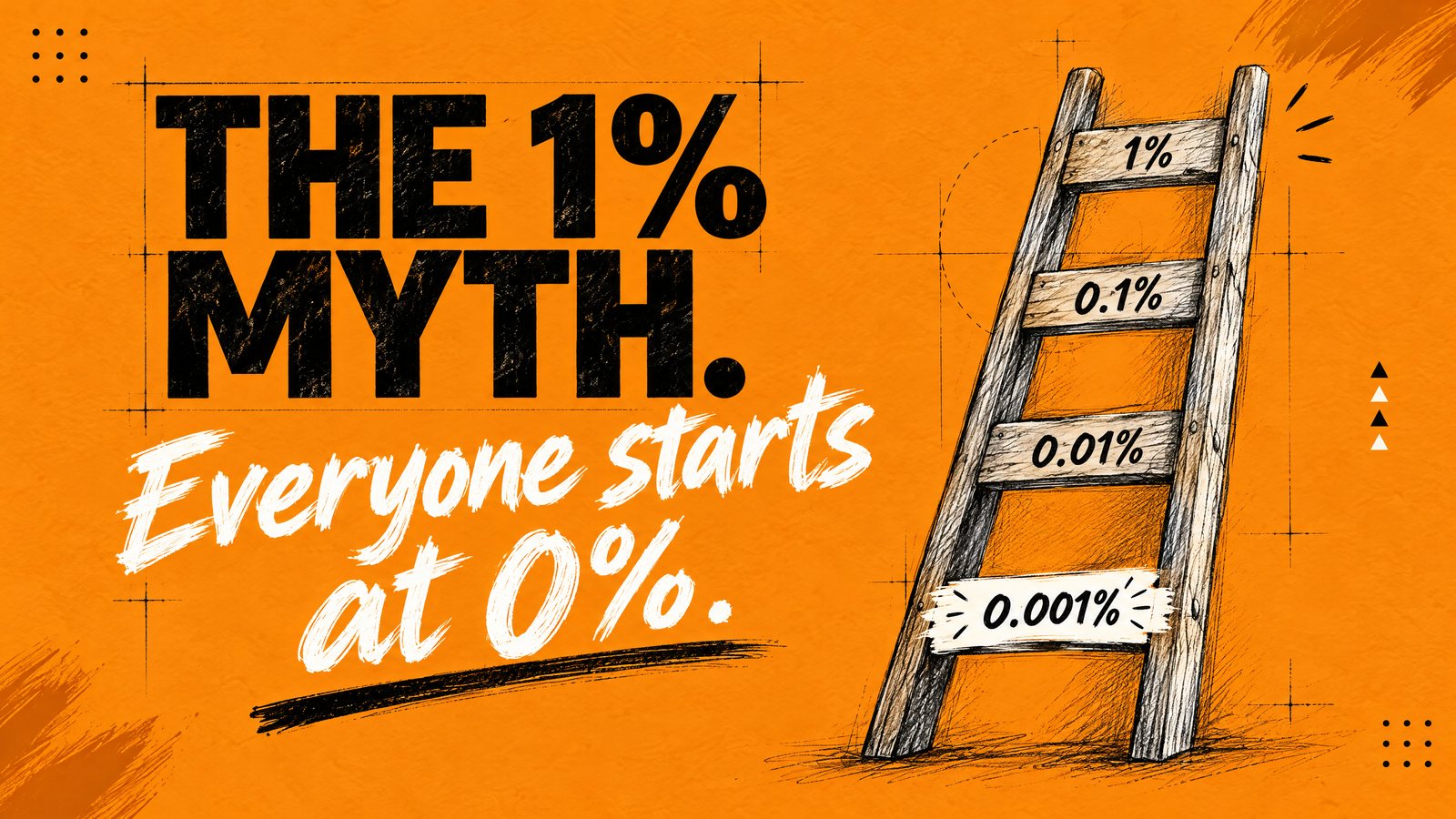
I have fantastic news...
We're gonna be rich!
Wait let me show you how...
You see...
Everyone loves the 1% math.
Let's say you find a statistic about your industry...
The headline states:
"Such-and-such market is a billion-dollar industry."
🤑 Someone close by (probably in the comment section) is going to say something like:
"Grab 1% of the market and you're rich."
Yep.
1% of $1 billion is a $10 million business!
💰💰💰💰💰💰
It sounds like proof.
But...
It's actually just a flex with no floor under it.
Why?
'Cause nobody starts at 1%... (I'll explain more of what I mean in a second)
So here's the test I run before I build anything.
Six steps.
No guessing.
Just the market, the ladder to scale in that market and the number that tells you the truth about your next brand venture...
1% of 1% of 1%: 6 Steps to Know If Your Niche Is Worth Building Around
Step 1 — Name your one ideal customer
❌ The vague crowd
"Busy professionals who want to grow."
That's not a customer.
That's a vague crowd wearing a name tag.
Here's the problem:
The wider the crowd / audience sounds, the safer it feels. It feels like a lot of customers.
It's not. It's the opposite.
Because a vague crowd has no single fear running through it.
But a customer does.
Jot down three things, in plain language:
- where this person lives (country)
- who they are on paper (age, income, role)
- the exact fear, problem or desire keeping them up at night
Nothing vague like "stress." Not "wants to grow."
The specific 2 a.m. thought.
✔ The move: Write one sentence.
"This is a 42-year-old operations manager in a mid-size U.S. city."
Then a second:
"The fear underneath everything: AI replaces her role before her kids are through college."
You see?
One person, one fear.
If you can't write those two sentences, you don't have a customer yet.
You just have a demographic.
Step 2 — Name your price and how you get paid
❌ Most people pick a price by feel, then bolt a billing model on after — one-time or subscription, whichever comes to mind first.
That's not a detail.
It's the single biggest lever in the whole model.
A $97 one-time sale and a $97-a-month subscription aren't close cousins.
Over a year, the subscription is worth twelve times more per customer.
Every number after this step multiplies off this one choice.
✔ The move: Jot down your exact price and whether it's one-time or recurring, monthly or annual.
Say it as plainly as your fear sentence.
"$97 a month."
Not
"somewhere around a hundred bucks, probably monthly."
Step 3 — Name your real starting number
❌ The trap here is aiming for a fantasy figure.
"$1M a year" feels ambitious.
It also makes almost every real niche look too small to bother with, before you've tested a single thing.
Bigger goals don't produce bigger outcomes.
Mostly they produce paralysis.
A goal too big for your real market kills a good idea before it gets a fair test.
✔ The move: Name the number you actually need, on an exact timeline.
"$50,000 a year."
"$10,000 a month."
A number tied to your actual life, not your ego.
Step 4 — Size the room
❌ Skipping straight to "let's see if I can land 1,000 customers," with no idea how many people could ever become one.
Ask Claude to find the total population that fits your Step 1 description, then the percentage of that group that experiences the exact fear or problem you named.
Multiply the two.
✔ The move: Ask AI directly...
Here's the prompt to give AI:
"My customer is [paste your Step 1 sentences]. Find the total population that matches this description. Then find what percentage of that group experiences [paste your exact fear or problem]. Show me your source for each number, then multiply the two together to get my Total Addressable Market."
That's your Total Addressable Market — your TAM — the entire room, before anyone's sold anything.
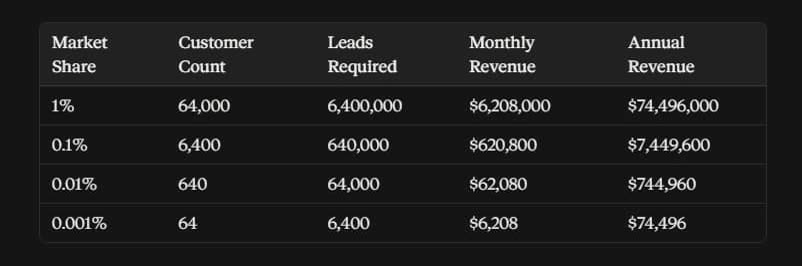
Here's a real run, on the GhostKit audience I tested — high-earning professionals dealing with a specific anxiety:
Step 5 — Build the ladder
❌ Staring at the whole TAM and imagining you'll capture a meaningful slice of it on day one.
16 Million Customers??!!!!
With our example of $97 each month from 16 million people we're going to be rich in no time!
WRONG.
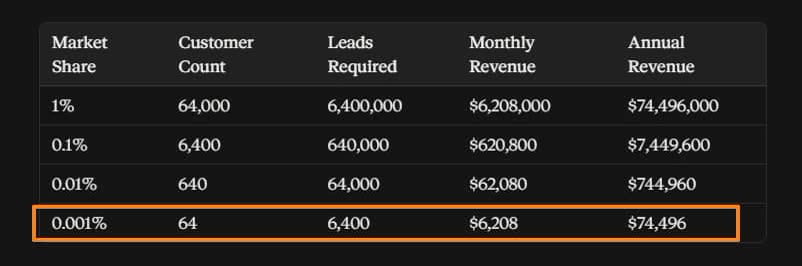
✔ The move: Split your TAM into four tiers — 1%, 0.1%, 0.01%, 0.001% — the ladder you have to climb, not skip.
Have Claude build this exact table for your numbers. Four rows. Five columns. No skipped tiers.
For each tier, multiply the TAM by the percentage to get a customer count.
Here's the prompt to give AI:
"My TAM is [your Step 4 number] people. My price is [your Step 2 price]. Build me a table with four rows — 1%, 0.1%, 0.01% and 0.001% market share. For each row, calculate the customer count (TAM × that percentage), the leads required (customer count ÷ a 1% conversion rate) and the monthly and annual revenue at my price. Label the columns Market Share, Customer Count, Leads Required, Monthly Revenue and Annual Revenue."
You see...
Brands get customers like this:
TAM -> % of TAM -> Leads -> % of Leads -> Customers
So the trick is to figure out how many leads you will get from the TAM at different market share %, how many customers can you get from the leads at each tier and how much revenue will you get from each market tier.
Here's our example laid out:
Step 6 — Read the ladder backward
The 1% trap: 1% conversion rate is a benchmark trap, not a guarantee.
Your real number could run higher or lower depending on the channel.
Treat the table as a floor to test against, not a promise.
So ignore the 1%...
THIS is the step almost nobody runs.
And it's the one that actually tells you the truth...
❌ Here's the myth. You've heard it before:
"This is a billion-dollar market. If I just get 1% of it, that's ten million dollars a year."
It sounds like proof.
When actually it's a flex with no floor under it.
Why?
Because you don't start at 1%.
Everyone starts at 0%...
(unless you acquire a company)
So you can't skip to the party.
To earn 1%, you first have to earn 0.1%.
Before that, 0.01%.
Before that, the smallest, most pessimistic slice of all: 0.001%.
So the key is to flip the table around.
Don't look at the top row first.
Look at the bottom row — 0.001%, the number you could plausibly hit while starting from zero, no reputation, no list.
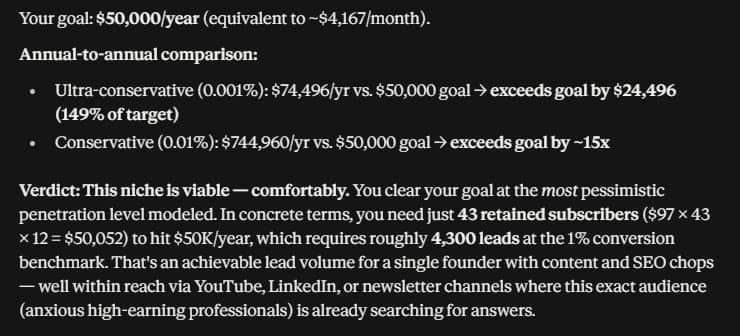
Compare that number to your Step 3 goal.
Here's our results...
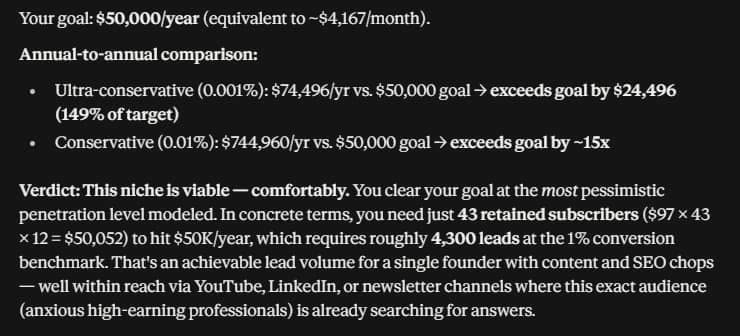
✔ The move: Compare your 0.001% and 0.01% rows to your Step 3 number, timeframe to timeframe.
If they clear it, you've got a niche worth building a world around.
If they don't, niche up or raise your price (realistically) before you write one more word of content.
The 1% flex was never a lie.
It was just the wrong end of the ladder to check first.
Need more in-depth help running this AI stuff for your brand world?
Reply to this email and say "I'm interested in more help."
That's the whole ask. Just reply.
My team and I will sit down with you and show you how to run your one customer avatar, your price and your real number through this exact ladder — so you know if a niche is worth building around before you spend one more hour on it.
You walk away with:
✔ Your TAM, sized with real numbers, not guesses
✔ Your full four-tier ladder, built for your price and your goal
✔ A straight answer — build this or widen it first
✔ A repeatable test you run on every idea after this one
✔ A step-by-step framework for building authority and thought leadership
✔ A sure-fire method to overcome the AI slop in your feed and your AI outputs...
Peace and Love,
J. Young El
P.S. —
Not ready for action yet?
Still, get on the GhostKits waitlist → links.jyoungel.com/ghostkits