The rules just changed (again)
To nail these rules home, I need to tell you about my girl Jamie…

She’s 45.
Director-level.
Generates about half a million a year in value her employer’s brand takes all the credit for.
Married, two children, a house in the suburbs of a mid-size metro — she’s looking to downsize though.
Pays for three AI subscriptions and is underwhelmed by all of them.
And she’s the best-kept secret in a field where louder, lesser operators keep walking off with the stages, the roles and the recognition…
.
.
.
If you’re reading this, it’s because you and Jamie are about 90% the same person. Same pains. Same wanting. Same silence.
Here’s the thing though.
Jamie isn’t real.
She’s my avatar. I built her.
And that feeling you just had — the one where a stranger described your career back to you in four lines — that’s the entire job. That’s what building one does.
Here are the five moves that got me there. Not one of them is “post more.”
The Main Rules
AI made Human Slop possible at scale.
Human Slop is what a person writes with nothing original in it. Regurgitated expertise. Somebody else’s take, reworded. The same six insights everybody in your field already agreed on. Nothing authentically theirs…
It was always around. It just used to cost you an afternoon.
Now it’s practically free with ChatGPT. Zero cost, zero effort, infinite volume.
And look what everybody’s spending it on. Your feed is a parade of people announcing themselves — their wins, their frameworks, their decade of experience, their hot take on the thing everyone already took hot.
Which is exactly why you should stop.
Make your brand about them. Not you.
These are the whole rules. Everything afterwards is how.
And it runs in a specific order:
Resonance first -> Expertise second -> Relevance last
That last one is going to bother you, so let me pay for it right now.
Relevance is your knowledge aimed at their world. It’s the most useful thing you own. And it goes dead last on purpose.
Because you already tried it.
Ten years of being the most useful person in the room. The one who actually knew. The one they came to when the thing broke.
Useful didn’t get you the room.
👆🏾 Relevance without resonance is a manual written by a stranger. Nobody reads the manual. They read the person.
Resonance is the door.
Expertise is why they stay.
Relevance is what you hand them once they’re inside.
Try handing it to them on the sidewalk and it’s litter.
Move 1 — Get off the fence.
In 2022 I had a personal brand with no person in it.
No face. No story. No opinion anybody could disagree with. Just knowledge — stacked, organized, well-written and completely unclaimed.
I call it the On-The-Fence Brand.
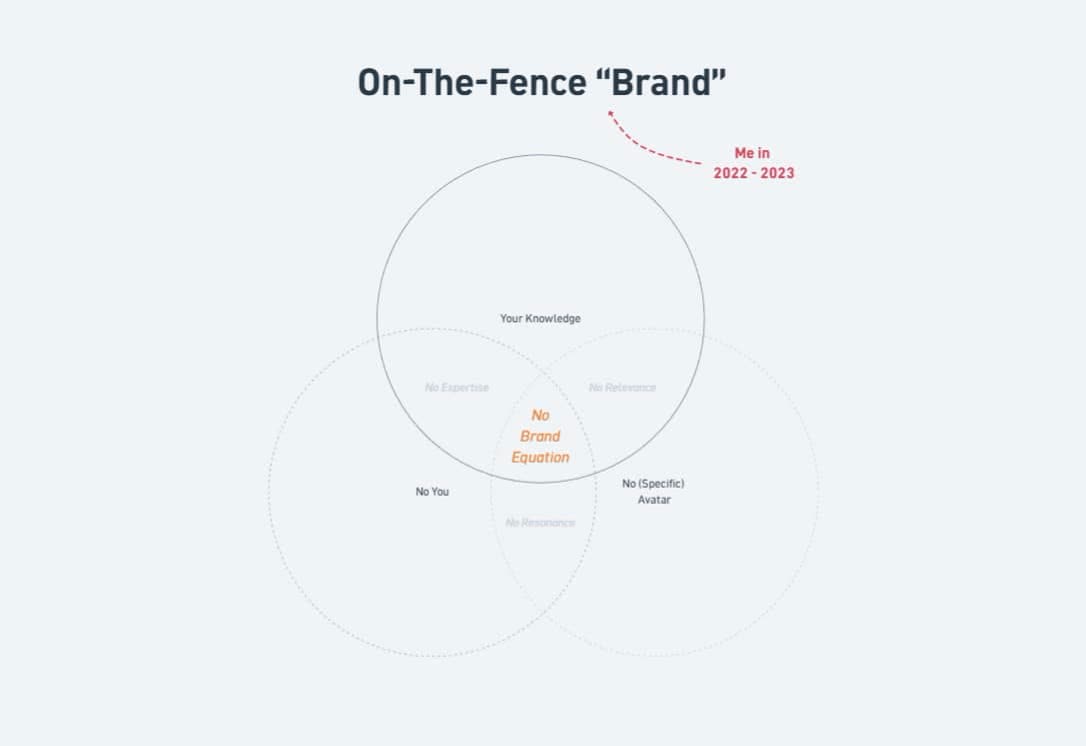
Here’s what it actually is: a library with no author or readers.
No person behind it, so no expertise.
No audience in front of it, so no relevance.
No personality driving it, so no resonance.
Every input reads as no.
And the vagueness wasn’t humility. I never decided who it was for — which means the niche was never made.
You can’t be on the fence about who you serve and be found by them.
The fence IS the invisibility.
Here’s the bill that came due:
602 days of building, without missing one.
Around 91,000 words published.
About 800 people reached.
Only $127.68 profited.
THAT’s consistency. THAT’s effort. That’s also nearly two years of my life.
Ouch…
Being invisible isn’t humble. Invisible is expensive.
.
.
.
And getting off the fence was never about becoming somebody new.
It’s about finally getting credit for who you already are…
Move 2 — Find out who, what and why.
Now go learn your audience.
Not what you assume about them.
Their real pains and the promises they’d happily pay you to keep.
Invisible experts skip this entirely.
You publish what you THINK your people care about, it lands on nobody and the silence comes back.
Say it with me. TEST. DON’T GUESS.
Guessing is the enemy. Testing is the answer.
Let me show you what it’s worth:
My friend Juan Cuevas sells shipping containers through his company Port Containers Direct. For years he fought for attention against a hundred other sellers listing the same “40ft shipping container” on Facebook Marketplace.
Sales were OK — but slowing. Every week the competition got stiffer, prices inched down and so did his margin.
Juan was sure he needed better ads. Slicker videos. More of everything.
WRONG.
On one call I asked him three questions:
Question 1
Me: Who buys from you most?
Juan: Farmers and ranchers.
Question 2
Me: What do they want?
Juan: Shipping containers.
Question 3
Me: Why do they say they use them?
Juan: Storage.
Case closed.
So I told him to change one thing. Stop selling “40ft Shipping Containers.” Start selling “Farm and Ranch Storage.”
Same steel box. Same photo. Four new words.
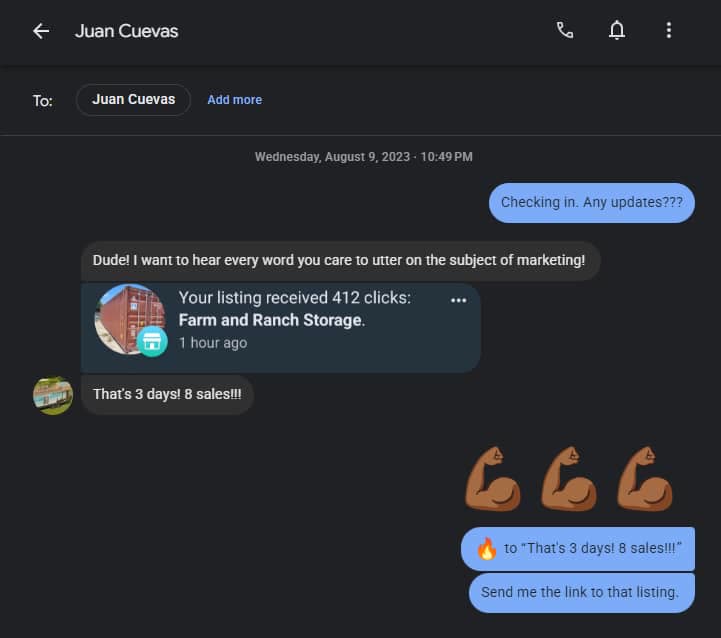
In a normal month Juan moved 15 to 20 containers total.
Before: about 1.5 sales every 3 days. After: 8 sales in 3 days.
That’s 5x…
Around $4,320 off a rename.
That’s nearly half a month of sales in a single weekend…
And it came from three questions that had nothing to do with the product.
Not the features.
Not the price.
Not his engagement rate…
About his audience —
His ideal customer persona —
His avatar.
That’s what happens when you use their words instead of yours. You stop shouting into the void and start getting heard.
My team and I call this Pain Mining.
Here’s the Pain Mining (lite) shortcut version.
Prompt your AI Mind with this:
I’m in the {your industry} industry.
I’m building a general audience of {your type of audience}.
- Find the handful of thought leaders my audience already trusts, already quotes, already buys from.
Study the offers those people are already selling.
- Then find and research through thousands of real conversations — comments, threads, reviews online — and pull out the exact words my audience uses to describe their pains and desired outcomes (promises).
Not my words. Theirs.
- Give me an estimate about: “Who are they?”, “What do they want?” and “Why do they want it?”
Save the data as a markdown report in my “Brand” folder
Within minutes, even with raw AI, you’ll have their words instead of your guesses.
Move 3 — Build your backstory.
Now the part nobody can copy.
Your backstory isn’t a resume. It’s proof you’ve stood where they’re standing.
Three blanks:
(Before) I struggled tremendously at {blank}.
(Turning point) Then I solved {blank}.
(After) Now others have solved {blank} with my {blank}.
Here’s mine, filled in:
(Before) For twenty years I made other people impossible to ignore — top earners in commercial real estate, rising stars at Microsoft. My own brand couldn’t crack 10 likes.
(Turning Point) Then I quit trying to out-write the problem and built myself an AI Ghostwriter — a system built on my own 10.2 million words — the same system I use for my ghostwriting clients.
(After) And now I show other invisible “behind the scenes” experts how to build their own AI Ghostwriter.
Notice what isn’t in there…
No credentials.
No title.
No here’s-my-resume-and-bio line.
Just:
I had your problem.
I found the fix to your problem.
I hand the solution to your problem to people like you now.
If your backstory doesn’t end where your avatar is currently standing, it’s an autobiography.
Not a backstory.
Autobiographies get read. Backstories get acted on.
Move 4 — Build their backstory.
Now write theirs. Same shape, but flipped.
(Current) They struggle tremendously at {blank}.
(Failed attempts) They tried {blank}, {blank} and {blank}.
(Desired outcome) They feel further from {blank} than ever.
Mine, for the invisible expert, reads like this:
(Current) My audience is brilliant. They know more than anyone in the room. And nobody outside that room knows their name.
(Failed attempts) They posted consistently and got crickets — so they decided they weren’t consistent enough. They bought the courses and followed gurus who contradicted each other — so they decided it was a scam, or that they weren’t cut out for this. They hired the PR team, the video crew, ran the ads. Real money out, nothing back. So they put their head down and told themselves the work would speak for itself.
It still hasn’t.
(Desired outcome) Somebody louder, with half the track record, is walking into the rooms and commanding the respect and rewards that should have been theirs.
👉🏾 The failed attempts matter more than the pain.
Their explanation for why each one failed is usually wrong. And that wrong explanation is exactly what’s keeping them stuck.
Name it, and you become the only person in their feed who’s read their mind.
Your Before Is Their Right Now
Map your backstory straight onto theirs:
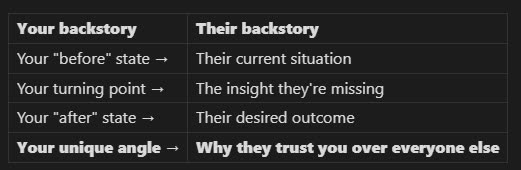
Line those up and you stop writing about your audience. You start writing from the exact spot they’re standing in.
Your before IS their right now. Same room, different year.
That’s when it all clicks — hooks, content, offers. Not because you got better at marketing. Because you finally quit guessing what it feels like over there.
Move 5 — Build an avatar.
Two backstories. One person.
An avatar is the one specific human who reads your stuff and thinks that was made for me. Not a demographic. A person — with a name, an age and a Tuesday.
Run this:
I’m in the {your industry} industry, building an audience of {your type of audience}.
Below is what I know about them: {paste the audience research from Move 2, plus the backstory you wrote in Move 4}.
Build me ONE avatar. A single named person, not a segment. Give me:
- SNAPSHOT — one paragraph: name, age, role, the money they generate versus the money they take home, family, where they live, what they spend on tools, and the one-line wound that defines them.
- DEMOGRAPHICS — age, gender, role, income, education, living situation, location, work setup. Cite a real external source for every line. If you can’t source it, say so. Do not fill the gap.
- A DAY IN THEIR LIFE — one paragraph. What they actually do between waking up and going to bed, and where the pain shows up in it.
- TOP PAINS AND DESIRED OUTCOMES — plain two-word labels, a short description under each. No jargon.
- WHAT THIS PERSON IS NOT — the disqualifiers. Who looks like them but will never buy from me.
Use their words, not mine. Where you’re guessing, label it a guess.
Then give them a face. Feed the snapshot paragraph it produces into any image generator:
Create a photorealistic headshot image of the following person.
{paste the SNAPSHOT paragraph, word for word}
1:1 square aspect ratio headshot of a surprisingly attractive, fashionable {man/woman}. The {man/woman} is captured in a crisp, mid-to-high contrast black and white photograph, while the background is a completely solid, vibrant orange (hex #F1943C).
Print it. Put it where you write.
Every post from here forward gets written to that one person. Not to your industry. Not to your network. Not to the algorithm.
To them.
And THAT’s resonance. Not a bigger audience. A specific one that feels met.
Remember Jamie?
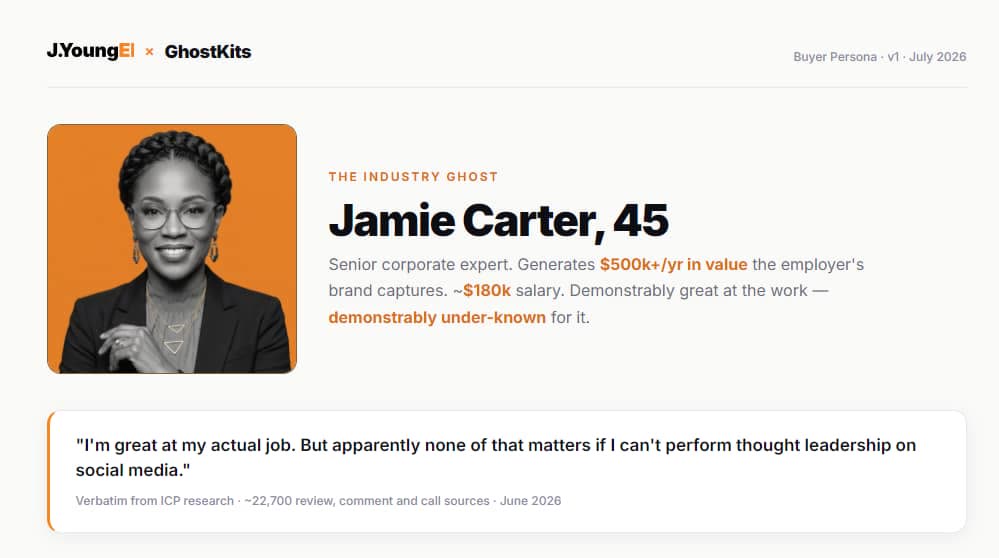
That’s her. That’s the face I’m looking at when I write every word of GHOST Stacks.
She isn’t a demographic. She isn’t “senior professionals, 40 to 55.” She’s a person with a name, a mortgage and a specific kind of tired.
And she’s the reason a stranger described your career back to you four minutes ago and got it right.
Much more on Jamie soon…
So here’s where that leaves you
Five moves. One job.
Make the person on the other end feel met before you ever try to teach them anything.
That’s all resonance is. And it’s step one of three.
Now notice what I didn’t cover.
I didn’t touch your voice — the thing that makes your writing unmistakably yours instead of one more AI echo in a feed full of AI echoes. You can run all five moves above and still sound like everybody else running them.
That one’s next. It’s the edition that kills the AI slop problem for good.
Two things before you go.
👉🏾One.
The actual skill files my team and I run for all five of these moves — the ones that do this in full detail instead of a single prompt — live inside the GhostKits Inner Circle.
Reply back “Let me in!” for the details…
👉🏾Two.
Hit reply and tell me which of the five you’ve never once done.
Not the one you’re worst at.
The one you’ve never done. I read every single one of these.
Peace and Love,
Jesse
P.S. Next edition: the questions that pull your voice out of your head and onto a page AI can actually run on. It takes about 30 minutes and it’s the closest thing to a cheat code I’ve found. Bring coffee…